Saturday, January 23, 2021

If I Follow Christ, What's in it for Me?

If anyone has ever asked you to do something hard, and it sounded like there was no good that could come from doing it, chances are you asked the person, "What's in it for me?" Honestly, that is a valid question. Humans are not prone to taking risks, unless they are aware of possible rewards they could receive. Here's a simple example: When I pour myself a tall glass of milk, I risk spilling the milk and having to clean it up. The reward I gain, though, for pouring the milk in my glass is I get to drink a refreshing glass of milk. That's my risk verses my reward.

The risk of being a Christian is quite clear. Jesus says, "Whoever wants to be My disciple must deny themselves and take up their cross daily and follow Me" (Luke 9:23). You must deny what you want, and instead take up what Jesus wants for you. What Jesus wants for you, is to take up your cross. Taking up one's cross, means just what it sounds like; willingly taking on torture unto death the same way Jesus did. That's what happened to all of Jesus' disciples. Peter, Paul, John, Stephen and Jesus' brother James were all tortured unto death for following Jesus. They all had lives they wanted to live, before they met Christ, but after they met Him, they denied themselves what they wanted and followed Christ, until they died. There's your risk; plain and simple. Following Jesus means you will not get what you want, and you will be tortured (in whatever form that may take), and you will die.

That's the risk. So, "What's in it for me?"

When you give your life to Jesus and follow Him as His disciple, you get a gift. Yes. Following Jesus means you get a free gift directly from God, and you can start using that gift in this lifetime. What is that gift? Well, there are many possible gifts you could receive from God. You could receive wisdom or knowledge through the Spirit (1 Corinthians 12:8). You could receive a desire to cheerfully share your possessions and give charitably to others (Romans 12:8). You could receive the gift of encouraging and lifting up others (Romans 12:8). You could receive the gitf of having great, maybe even unwaivering, trust in the Lord (1 Corinthians 12:9). You could also receive the gift of being able to heal others (1 Corinthians 12:9). You could get the gift of being able to speak fluently in a different language (1 Corinthians 12:10). You could even receive the gift of discernment to rightly understand the Word of God (1 Corinthians 12:10). Any one of these possibilities, along with plenty more, could be given to you, when you follow Christ.
In the days after Jesus ascended into heaven and His apostles remained on earth
they were given the spiritual gift to evangelize in various languages (Acts 2:1-6).

Please note, no one person is going to get all of these gifts, or even a large amount of them. Paul writes that we all have different gifts (Romans 12:8), and that gifts among Christians work together like parts of a body. Pay careful attention to what Paul writes here in 1 Corinthians chapter 12 verses 12 to 14:

Just as a body, though one, has many parts, but all its many parts form one body, so it is with Christ. For we were all baptized by one Spirit so as to form one body-whether Jews or Gentiles, slave or free-and we were all given the one Spirit to drink. Even so the body is not made up of one part but of many.

Only people who have been baptized by the Spirit (that is to say are followers of Jesus) have any of the afforementioned gifts. No one person gets all of them, because God has ordained that Christians will have to work together with each other for our common good. When we are in Christ, no title about us matters more than the title of "Christian." This is so much so that any other titles applicable to ourselves no longer matter; like they don't even exist (Galatians 3:28). What matters is that we are in the body of Christ, and we are working for His good.

Now, all I've done so far is tell you about all the good Spiritual gifts that you can receive from being a follower of Christ. Take any of those gifts, even the gift of miraculous powers (1 Corinthians 12:10), and it pales in comparison to the greatest reward you get from following Christ.

When you follow Christ, you get Christ. That is the reward you gain for your risks, and this reward has infinite value. 

Jesus says to His followers, "I am the vine; you are the branches. If you remain in Me and I in you, you will bear much fruit; apart from Me you can do nothing" (John 15:5). You will have a fruitful life, because you have Jesus; a life full of purpose and worthwhile abundance (John 10:10). You'll also have a fruitful afterlife. Those in Christ will inherit a place in the Kingdom of God. Christ's followers are known as children of God. Paul writes, "Now if we are children, then we are heirs-heirs of God and co-heirs with Christ, if indeed we share in his sufferings in order that we may also share in his glory" (Romans 8:17). Yes, we take up our cross as Jesus did, and we die for following Christ, but we will also share in glorifying the Father as Jesus did. One day we who have been made alive in Christ (Ephesians 2:5), will all together sing praises to God, proclaiming, "To him who sits on the throne and to the Lamb be praise and honor and glory and power, for ever and ever!" (Revelation 5:13). That, truly, is what is in it for you and me; an eternity of praise and glory with our creator, as a royal heir in His Kingdom.
All of God's followers and all of His angels
will sing praises unto Him (Revelation 5:11-13).
With what I have just told you about the risk and reward of following Jesus, now read these words from the Lamb of God, as they are written down in Matthew chapter 6 verses 31 to 33:

So do not worry, saying, ‘What shall we eat?’ or ‘What shall we drink?’ or ‘What shall we wear?’ For the pagans run after all these things, and your heavenly Father knows that you need them. But seek first His kingdom and His righteousness, and all these things will be given to you as well.

Don't focus on the gifts you get from following God. Focus on the beatiful and good God who will give you wonderful gifts. Seek His Kingdom above all things, and He will give you all the rewards you need to meet the risks of following and serving Him. What's in it for you is better than either one of us could imagine.

I can only imagine
What it will be like
When I walk by Your side
I can only imagine
What my eyes would see
When Your face is before me
I can only imagine
-MercyMe

Sources

Thursday, January 14, 2021

Matthew 7:12 (The Golden Rule)

Matthew 7:12
So in everything, do to others what you would have them do to you, for this sums up the Law and the Prophets.

If you attended public school in the 1990s or prior, chances are you saw posters and signs in the hallways that said, "Remember the Golden Rule." Signs such as these seem to have faded out of school decor. Some of us are familiar with the "Golden Rule," but in these days one cannot be too careful with Biblical knowledge. Many things in our world today want to lap up Biblical truth or dilute it down until it's akin to poison rather than living water. For a useful refresher, or perhaps for a first time overview, let's examine the "Golden Rule," its Biblical context and its real-world applications.

The "Golden Rule" is the simple statement, "Treat others the way you want to be treated." Although the "Golden Rule" is not the first piece of wisdom given about the treatment of others, as the Chinese philosopher Confucius said, "What you do not wish for yourself, do not do to others," the "Golden Rule" is wisdom that is pro-active rather than passive. It is not simply about not doing bad things, but about actively doing good things for others. The "Golden Rule" is wisdom given to change one's perspective about how they treat others, and to make them think about what good things they can do that they would like done for themselves.

The "Golden Rule" comes from Jesus' famous Sermon on the Mount. Early on near the start of Jesus' mission He spoke to a large crowd gathered on a mountainside. He sat down on the mountain and taught everyone who was there beautiful things about the Kingdom of God. In this sermon just after He talks about people's need for right judgement, Jesus says, "Ask and it will be given to you; seek and you will find; knock and the door will be opened to you. For everyone who asks receives; the one who seeks finds; and to the one who knocks, the door will be opened" (Matthew 7:7-8). Jesus did not say this to imply that we, as God's children, can ask for anything from God and it will be given to us. What He is saying is that our heavenly Father longs to give His children good gifts, and He knows what is best for us. We can ask God for good things, and know that God will give them to us, because God is good. Jesus then says on the matter of people receiving and giving good gits that God's children should, "do to others what you would have them do to you, for this sums up the Law and the Prophets" (Matthew 7:12).

When we, as God's children, do to others what we would have them to do to us, we do what God does for us. We give others good gifts from heaven, by doing good things for others. There are many good gifts we can give. We can give charitably. We can show mercy. We can forgive others. We can give others the wisdom from God. We can judge rightly. We can be gentle with others. We can be slow to anger against others. We can be compassionate. We can encourage. We can do all these things actively for others with the love of God, because God is with us. 

We should not do these things expecting that others will do them for us, though. Only we, God's children, can do good things for others. Everyone who is not a child of God in this world is apart from God, and can do no good. Jesus said, immediately after stating the "Golden Rule," "Enter through the narrow gate. For wide is the gate and broad is the road that leads to destruction, and many enter through it. But small is the gate and narrow the road that leads to life, and only a few find it" (Matthew 7:13-14). Those on the path to destruction can only cause destruction, but we, as God's children, have entered through the narrow gate to Christ, and so we can show the love that others cannot.
Take a moment to compare the sayings of those on the wide road leading to destruction
to God's good wisdom that leads through the narrow gate..
God's children are called to love others the way God loves us. Jesus says the greatest commandement is to "love the Lord your God with all your heart and with all your soul and with all your mind.' This is the first and greatest commandment. And the second is like it: ‘Love your neighbor as yourself.’ All the Law and the Prophets hang on these two commandments" (Matthew 22:37-40). When we love others in this way, the world sees that we are indeed followers of Jesus Christ, the one true King (John 13:34-35). The world will see we are different, and they will know who it is we serve by how we love others.

Sources

Friday, January 8, 2021

What was 2020? (Clarity into our Hearts)

We are in the next 365 days of the world. Even though the old year of 2020 is behind all of us (and many would say is "finally" behind us), those 366 previous days are not so far in our past. We cannot simply discard the previous year in the same way we can our old calendars. Those days don't just go in the trash. Everything that we did during them, according to whatever goals we may have had, will directly or indirectly shape our lives. Each year is the effect of the previous year and the cause of the next. Right now, we are little more than a week into the effects of the previous year. So, let's look back on it for a moment.

I, like many people, came into 2020 rather superstitously and foolishly considering that its double double digits were a, so to speak, good omen of some kind. I heard many wise-cracks about how the year meant the return of the roaring 20s and good times. People seemed generally optimistic about the year, myself included. Then, it all went up in flames. By the end of the year, many people I know did not ceremoniously say so long to 2020, as much as they told 2020 to crawl in a hole and die. I'll not reiterate what came about in the world, during 2020. I am writing to address an aspect we should consider about 2020; something we should learn.
At some point in the summer of last year, I began to refer to 2020 as "The Year of Clarity." This title jokingly comes from the number eye doctors give patients with perfect vision, 20 20. What I primarily mean to say is that 2020 was the year that everyone could see clearly what people are like. Well, did you like what you saw in others as well as yourself? I didn't.

Many things that happened during 2020 stretched people to their limits. The common and unobtrusive parts of our life were all effected by the strains unleashed that year. For many it seemed there was nowhere they could go or to no one they could go to find release or reprieve from the tortures of the year. What did people show, during these times? They showed frustration, stress, bitterness, derision, corruption, rage, depression, fear, isolation, intolerance, cowardice and mortality. That is what I saw in others as well as myself with the clarity that came from the prying and revealing times of 2020.

There is no reason for us to be surprised by this. The Bible tells us just as much. We all move and act in accordance with what is in our hearts. According to the Scriptures, "The heart is deceitful above all things and beyond cure. Who can understand it?" (Jeremiah 17:9). Jesus said, "out of the heart come evil thoughts-murder, adultery, sexual immorality, theft, false testimony, slander" (Matthew 15:19). Our hearts with which we are born are wicked and hideous. If you are too proud to think of yourself as prone to sinfulness, know this, "The Lord detests all the proud of heart. Be sure of this: They will not go unpunished" (Proverbs 16:5). Do not take God's diagnosis of your heart lightly.
This campaign poster was made as a joke, but it unkowingly tells the truth
that everyone is a born sinner without exception (Romans 3:23).
We may not always see this truer darker side of all of us, but God does. He saw it last year and the year before that and the year before that. We may have needed the clarity that came with 2020 to remind us who we are and what we do, but God knows all our hearts all the time. He is the light that shines in on our most feared places to be exposed. He is the light that has come into this world to call people back into His light, but people naturally love the darkness and flee from Him. This is what is meant in the gospel of John where it reads, "Everyone who does evil hates the light, and will not come into the light for fear that their deeds will be exposed" (3:20). 

This is dark news, to be sure, and it is the truth. We are all born with warped and sinful hearts. This is who we are, but this is not how God leaves us. 

It is written to those who follow the LORD, He says to them, "I will give you a new heart and put a new spirit in you; I will remove from you your heart of stone and give you a heart of flesh" (Ezekiel 36:26). Apart from God, following our wicked hearts, we are dead, but with a new heart from God we can live and live abundantly. As Jesus says, "The thief comes only to steal and kill and destroy; I have come that they [my followers] may have life, and have it to the full" (John 10:10). All you need to experience this present and eternal abundant life is to do as God says, "Turn to Me and be saved, all you ends of the earth; for I am God, and there is no other" (Isaiah 45:22). When we turn away from our sins and are saved, we are no longer ashamed to come into the light. As it is written in the Scriptures, we will have all our sins removed from us like a filthy shirt, and we will be given new clean and beautiful clothes (Zechariah 3:4). We will be children of God (John 1:12). We will have new life in Christ.

Let us be the first to welcome you
Welcome to the
Life you thought was too good to be true
Welcome to the new
- MercyMe

We must turn away from the wicked desires of our hearts of stone, and earnestly desire to receive a new heart in Jesus Christ. Without Jeses Christ we can do no good, and neither can others. If we desire good things to be ever present and thriving in our world, then we all need the salvation of Christ. This need for salvation is not simply something for us in this year, but something God has placed in every heart that lived in every year. Charles Spurgeon, a great preacher who lived in Victorian Britain, told this to his church congregation on the new year of 1856:

Take this, dear friends, for a new year's text, both ye who love the Lord, 
and ye who are only looking for the first time. Christian! in all thy troubles 
through this year, look unto God and be saved. In all thy trials and afflictions, 
look unto Christ, and find deliverance. In all thine agony, poor soul, in all 
thy repentance for thy guilt, look unto Christ, and find pardon. This year, 
remember to put thine eyes heavenward, and thine heart heavenward, too.

Charles Spurgeon was 22 when he gave that sermon, so don't let anyone
look down on you, Christian, because of your youth (1 Timothy 4:12). 
2020 brought us all many trials and afflictions, and each year will bring new trials and afflictions (some years more than others). How we face them is up to us. Will we fix our eyes on God, knowing that through Him we have salvation and can do good things for others, or will we stay miserable and deceived by our wicked hearts? The choice is ours. As for me, I pray that this year I will grow in Christ, even though I fall short of His glory every day. I pray I will continue to serve the LORD and remember to bless His name no matter what comes.

Blessed Be Your Name
In the land that is plentiful
Where Your streams of abundance flow
Blessed be Your name
Blessed Be Your name
When I'm found in the desert place
Though I walk through the wilderness
Blessed Be Your name
- Matt Redman

How will you fill your first month of the new year?


Sources

Sunday, December 27, 2020

1 John 4:16 (God is Love)

1 John 4:16
And so we know and rely on the love God has for us.
God is love. Whoever lives in love lives in God, and God in them.

Love is a virtue traditionally associated with Christmastime, however love is not only present in a Christian's life during the Christmas season. More than any other virtue; love must abide in a Christian's heart all year long. So, what is "love"?

Perhaps more than any other virtue, the world misunderstands "love". "Love" in the Bible is nothing like what love is in the world, and there is no near equivalent to Biblical "love" in the world to help us understand "love" outside of the Bible. "Love" in the New Testament is ἀγάπη (agapé). Agape is a type of love; a type of affection, benevolence or appreciation for something much like the love the world understands. Agape, though, is not a love found in the world but a "love" all its own. It's so seperate from the world, that according to the Bible Dictionary, it "is rarely used in extrabiblical Greek texts. It was used by believers to denote the special unconditional love of God." This "love" has been made known to humanity through the Word of God and the person of Jesus Christ.

The Bible clearly says that this "love" is not just from God, but that it is God. God is "love." The disciple John wrote to devout believers, "We know and rely on the love God has for us. God is love. Whoever lives in love lives in God, and God in them" (1 John 4:16). John says that those who believe in God rely on Him, and God lives in them. Since God is "love" and only Christians can have God in their hearts, then only Christians can truly "love." With this knowledge we, as believers, know that we are the only people on earth capable of showing true "love," as a demonstration of the "love" God has for us. The "love" God displays for us, and that we can display for each other, is described by Paul in some very famous verses. Paul wrote this of "love" in 1 Corinthians 13:4-7:

4 Love is patient, love is kind. It does not envy, it does not boast, it is not proud. 5 It does not dishonor others, it is not self-seeking, it is not easily angered, it keeps no record of wrongs. 6 Love does not delight in evil but rejoices with the truth. 7 It always protects, always trusts, always hopes, always perseveres.

This is the "love" believers have. This is the "love" God has given us, and He gave this "love" to us in the person of Jesus Christ on the first Christmas. This gift of "love" is powerful. Paul describes that the gift of "love" will not pass away, even after the gifts of knowledge, languages and prophecies all cease (1 Corinthians 13:8). Paul concludes on "love" with the following, "these three remain: faith, hope and love. But the greatest of these is love" (1 Corinthians 13:13).

Paul wrote of what the virture of "love" is, while John wrote of who the person of "love" is. John writes, "This is how we know what love is: Jesus Christ laid down his life for us. And we ought to lay down our lives for our brothers and sisters" (1 John 3:16). God is "love", and God came to us on Christmas, as an act of "love." He laid down His life for us, so that we may know what true "love" is, and that we may show that "love" to the world. The world will wonder and ponder at this until the end of time. It is our mission, as Christians, to point those in the world to what "love" is, so that "love" may abide in the hearts of everyone on earth. We must cry out, "Make way for God," because He is with us. He is here.

Here is our King
Here is our Love
Here is our God who's come
To bring us back to Him
He is the One
He is Jesus, Jesus
-David Crowder Band

Sources

Tuesday, December 22, 2020

What did Mary Know?

Mark Lowry's "Mary, Did You Know?" tells of the true nature of Jesus Christ through the perspective of an omniscient narrator asking Mary, the mother of Jesus, if she knows all the amazing things that her baby will do when He becomes an adult. It is a beautiful work of musicality, especially in how it builds in power and passion the more the lyrics reveal about Jesus' divine nature as God's perfect son. It is a truly wonderful song.

Mary, did you know that your baby boy
Is Lord of all creation?
Mary, did you know that your baby boy
Would one day rule the nations?
Did you know that your baby boy
Is heaven's perfect Lamb?
That sleeping child you're
Holding is the great, I Am
-Mark Lowry

Of course, with the existence of this song comes the existence of an important question: What did Mary know?

Mary first knew she would give birth to a son when the angel Gabriel appeared before her. In the first chapter of Luke Gabriel tells Mary that even though she is a virgin she will give birth to a son. Gabriel then says the following about Mary's son, "He will be great and will be called the Son of the Most High. The Lord God will give Him the throne of His father David, and He will reign over Jacob’s descendants forever; His kingdom will never end" (Luke 1:32-33). There's alot of amazing parts to what Gabriel promises about Mary's son, but they might not all be clear upon first read. 

One thing Gabriel tells Mary is that her son will be the Son of the most High. The one who is most high is God. The Son of God is typically refered to in the Old Testament as the Son of Man. The Son of Man appears predominantly in two prophetic books in the Old Testament. The first one is Ezekiel. In this book the Son of Man appears before God's prophet in a vision. Ezekiel writes that he saw "what looked like a throne of lapis lazuli, and high above on the throne was a figure like that of a man" (Ezekiel 1:26). Ezekiel also writes, "brilliant light surrounded Him. Like the appearance of a rainbow in the clouds on a rainy day, so was the radiance around Him" (Ezekiel 1:28). When imagery of bright light is primarily used in Scripture, it refers to God and His goodness. This is shown at the beginning of the Bible, where God's first words are, "Let there be light" (Genesis 1:3). This is also evident in Isaiah where it is written, "The people walking in darkness have seen a great light; on those living in the land of deep darkness a light has dawned" (Isaiah 9:2). Knowing that light Biblically siginifies God's glory and goodness, it makes sense why Ezekiel's response to seeing the Son of Man was to fall down before Him, as one falls down and worships the LORD (Ezekiel 1:28).

The Son of Man appears also in the book of Daniel. One night in a vision the prophet Daniel sees, "one like a Son of Man, coming with the clouds of heaven" (Daniel 7:13). Daniel then says that the Son of Man entered into the pressence of the Ancient of Days, which is a title for the LORD Almighty, God the Father. Daniel then writes of the Son of Man, "He was given authority, glory and sovereign power; all nations and peoples of every language worshiped Him. His dominion is an everlasting dominion that will not pass away, and His kingdom is one that will never be destroyed" (Daniel 7:14). From this vision the Son of Man is a figure who is like a man, but is as holy and almighty as God, for only someone like that could stand in God's pressence. The Son of Man is also worthy of worship, the same way only God is. His reign as King over all will never come to an end. This description of the Son of Man is directly related to how Gabriel says of Jesus, "He will reign over Jacob’s descendants forever; His kingdom will never end" (Luke 1:33). 
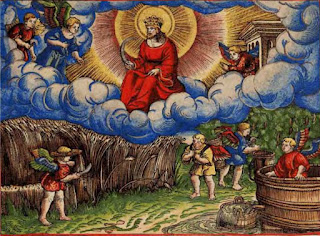
The Son of Man also appears in the New Testament in Revelation 14:14-16
where He is shown as one who reaps the harevest of believers on earth.
Based only on what the angel Gabriel told mary about her child being the Son of Man, and Mary's likely knowledge of these great prophecies from Ezekiel and Daniel, Mary knew that her child would be one who is like God, who is Light, King and has all power and autority and is worthy of worship. The only one who is like God can be someone who is God. This is why it can be concluded that Mary knew she would give birth to a son, and He would be God on earth with us (Isaiah 7:14).

Mary knew this, because she heard the angel Gabriel tell her this, but how come others besides Mary would come to know this as well? They would know because their eyes and hearts would be made open to this truth. Simon Peter after his first encounter with Jesus, upon seeing Jesus demonstrate signs and speak wonders, went up to Jesus fell at His knees and said, “Go away from me, Lord; I am a sinful man!" (Luke 5:8). He rightly knew that Jesus was holy and Lord of all creation, despite that no angel told him. Later in Peter's life, Jesus tells Peter how it is he came to recognize Jesus' true nature. Jesus says to him, “Blessed are you, Simon son of Jonah, for this was not revealed to you by flesh and blood, but by my Father in heaven" (Matthew 16:17). Peter knew who Jesus is, because God made it known to Him.

God does not make known the nature of Jesus to everyone, though. Jesus Himself said of some of those who heard Him speak and preach, "they may be ever seeing but never perceiving, and ever hearing but never understanding; otherwise they might turn and be forgiven!" (Mark 4:12). This is also similar to what God told the prophet Isaiah to tell His people. God said, "'Be ever hearing, but never understanding; be ever seeing, but never perceiving.’ Make the heart of this people calloused; make their ears dull and close their eyes. Otherwise they might see with their eyes, hear with their ears, understand with their hearts, and turn and be healed" (Isaiah 6:9-10). What all this means is that knowing about God and His ways is entirely in God's hands. God knows who will be His followers, and He has put this destiny in place for them that will believe before they were even born (Romans 8:29). Don't forget, though, that you, as a believer, still had your own part in knowing God. You had to turn from your wicked ways and desire Him, so that you may be forgiven for your sins. It is written that those who turn from their sins and seek God will find Him (Jeremiah 29:13).

We live in an age where we know about Jesus not from seeing Him physically, but from God revealing Him to us through what we hear about Jesus and learn about Jesus through God's words, the Bible. If the true nature of Jesus as the Son of Man and God in flesh has been revealed to you, then consider yourself truly blessed. Jesus said of believers like you and me, "blessed are those who have not seen and yet have believed” (John 20:29). Though we have not seen Jesus in His physical body, nor have we seen Jesus perform signs and wonders in person before our eyes, we know who He is, because God has revealed this to us. Just as Mary knew, so do we in Christ know, because God has revealed Himself to us. We know that God is here.

Love has come
For the world to know
As the wise men knew
Such a long time ago
And I believe that angels sang
That hope had begun
When the God of glory
Who is full of mercy
Yes, the God of glory
Sent His son
(Yes! We know that!)
-Amy Grant

Sources